



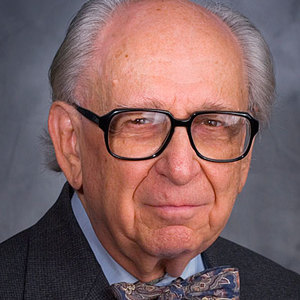

Herbert C. Kelman
IN MEMORIAM
Professor Herbert C. Kelman died March 1, 2022, in Cambridge, Massachusetts, at the age of 94. Social Psychology Network is maintaining this profile for visitors who wish to learn more about Professor Kelman's work.
Please see below for more information:
- Social Scientist, Scholar Herbert C. Kelman, 94 (Harvard Gazette)
- An Obituary for Herbert C. Kelman: 18 March 1927 – 1 March 2022 (Kelman Institute)
- Farewell to a Psychologist Who Brought Israelis and Palestinians Together (Haaretz)
Professor Kelman received his Ph.D. at Yale University, where he worked with Carl Hovland in the early days of the Yale attitude change project. He first came to Harvard in 1957 as Lecturer on Social Psychology in the Social Relations Department. In 1962 he moved to the University of Michigan as Professor of Psychology and Research Psychologist in the Center for Research on Conflict Resolution. He was an active participant in and for a while chair of the Joint Doctoral Program in Social Psychology. In 1968 he returned to Harvard as Richard Clarke Cabot Professor of Social Ethics, a chair originally held by Gordon Allport. From 1994-97, he chaired Harvard's Doctoral Program in Social Psychology. In 1999, he retired from teaching, but continued as Richard Clarke Cabot Research Professor of Social Ethics. In 2004, he became Richard Clarke Cabot Professor of Social Ethics, Emeritus.
The theoretical focus of Professor Kelman's work throughout his career has been social influence and attitude change, with an emphasis on the distinction between different processes of influence; on the relationship of action to attitude change; and on conceptions of personal responsibility for actions ordered by legitimate authorities. The last of these topics is the subject of his book, Crimes of Obedience: Toward a Social Psychology of Authority and Responsibility, coauthored with V. Lee Hamilton (1989). He has explored influence processes in various applied settings, including psychotherapy, international educational exchanges, and more recently, problem-solving workshops in the resolution of international conflicts.
The latter work bridges his work on social influence and attitude change with his other long-standing interest in the social psychology of international relations. His work in conflict resolution has concentrated for a number of years on an action research program on the Arab-Israeli conflict. He has developed interactive problem solving, an unofficial third-party approach to the resolution of international and ethnic conflicts, anchored in social-psychological principles, and he and his colleagues have applied this approach to the Israeli-Palestinian conflict and to other protracted conflicts between identity groups. He is associated with Harvard's Weatherhead Center for International Affairs, where he directed the Program on International Conflict Analysis and Resolution (PICAR) between 1993 and 2003 and co-chairs the Middle East Seminar.
Professor Kelman has also written and lectured extensively on the ethics of social research and social intervention, including ethical problems in human experimentation and the social consequences of psychological and social research.
Primary Interests:
- Aggression, Conflict, Peace
- Applied Social Psychology
- Attitudes and Beliefs
- Culture and Ethnicity
- Ethics and Morality
- Group Processes
- Intergroup Relations
- Persuasion, Social Influence
- Political Psychology
- Self and Identity
- Sociology, Social Networks
Research Group or Laboratory:
Note from the Network: The holder of this profile has certified having all necessary rights, licenses, and authorization to post the files listed below. Visitors are welcome to copy or use any files for noncommercial or journalistic purposes provided they credit the profile holder and cite this page as the source.

Video Gallery

Conflict Resolution (Brainwaves Video Anthology)
Select video to watch
-
10:00 Conflict Resolution (Brainwaves Video Anthology)
Length: 10:00
-
11:30 Ethics and Obedience to Authority
Length: 11:30
-
2:09:24 Parents of Peace and Conflict Studies: An Interview
Length: 2:09:24
-
1:10 Psychologists for Social Responsibility: An Interview
Length: 1:10
-
2:43 Teachers Make a Difference: Carl I. Hovland
Length: 2:43
-
1:10:46 Master's Series on Field Research
Length: 1:10:46
-
1:02:31 Kelman Seminar Series: A Tribute to Herbert C. Kelman
Length: 1:02:31
Additional Videos
Books:
- Bermant, G., Kelman, H. C., & Warwick, D. P. (Eds.). (1978). The ethics of social intervention. Washington, DC: Hemisphere Publishing Corporation.
- Kelman, H. C. (1968). A time to speak: On human values and social research. San Francisco, CA: Jossey-Bass.
- Kelman, H. C. (2018). Transforming the Israeli-Palestinian conflict: From mutual negation to reconciliation. New York: Routledge.
- Kelman, H. C. (2017). Resolving deep-rooted conflicts: Essays on the theory and practice of interactive problem-solving. New York: Routledge.
- Kelman, H. C. (Ed.). (1965). International behavior: A social-psychological analysis. New York: Holt, Rinehart and Winston.
- Kelman, H. C., & Ezekiel, R. S., with the collaboration of Kelman, R. B. (1970). Cross-national encounters: The personal impact of an exchange program for broadcasters. San Francisco, CA: Jossey-Bass.
- Kelman, H. C., & Fisher, R. J. (Eds.). (2016). Herbert C. Kelman: A pioneer in the social psychology of conflict analysis and resolution. Springer.
- Kelman, H. C., & Hamilton, V. L. (1989). Crimes of obedience: Toward a social psychology of authority and responsibility. New Haven, CT: Yale University Press.
Journal Articles:
- Kelman, H. C. (1961). Processes of opinion change. Public Opinion Quarterly, 25, 57-78.
- Kelman, H. C. (1972). The rights of the subject in social research: An analysis in terms of relative power and legitimacy. American Psychologist, 27, 989-1016.
- Kelman, H. C. (1973). Violence without moral restraint: Reflections on the dehumanization of victims and victimizers. Journal of Social Issues, 29(4), 25-61.
- Kelman, H. C. (1983). Conversations with Arafat: A social-psychological assessment of the prospects for Israeli-Palestinian peace. American Psychologist, 38, 203-216.
- Kelman, H. C. (1997). Group processes in the resolution of international conflicts: Experiences from the Israeli-Palestinian case. American Psychologist, 52, 212-220.
- Kelman, H. C. (2007). The Israeli-Palestinian peace process and its vicissitudes: Insights from attitude theory. American Psychologist, 62(4), 287-303.
- Kelman, H. C. (2008). Evaluating the contributions of interactive problem solving to the resolution of ethnonational conflicts. Peace and Conflict: Journal of Peace Psychology, 14(1), 29-60.
- Kelman, H. C. (2010). Looking back at my work on conflict resolution in the Middle East. Peace and Conflict: Journal of Peace Psychology, 16(4), 361-387.
- Kelman, H.C. (2010). Interactive problem solving: Changing political culture in the pursuit of conflict resolution. Peace and Conflict: Journal of Peace Psychology, 16(4), 389-413
Other Publications:
- Kelman, H. C. (2006). Interests, relationships, identities: Three central issues for individuals and groups in negotiating their social environment. In S. T. Fiske, A. E. Kazdin, & D. L. Schacter (Eds.), Annual Review of Psychology (Vol. 57, pp. 1-26). Palo Alto, CA: Annual Reviews.
- Kelman, H. C. (2004). Continuity and change: My life as a social psychologist. In A. H. Eagly, R. M. Baron, and V. L. Hamilton (Eds.), The social psychology of group identity and social conflict: Theory, application, and practice (pp. 233-275). Washington, DC: American Psychological Association.
- Kelman, H. C. (1980). The role of action in attitude change. In H. E. Howe, Jr., and M. M. Page (Eds.), Nebraska Symposium on Motivation, 1979: Attitudes, values, and beliefs (pp. 117-194). Lincoln, NE: University of Nebraska Press.
- Kelman, H. C. (1997). Social-psychological dimensions of international conflict. In I. W. Zartman and J. L. Rasmussen (Eds.), Peacemaking in international conflict: Methods and techniques (pp. 191-236). Washington, DC: U.S. Institute of Peace.
- Kelman, H. C. (2001). Dignity and dehumanization: The impact of the Holocaust on central themes of my work. In P. Suedfeld (Ed.), Light from the ashes: Social science careers of young Holocaust refugees and survivors (pp. 197-220). Ann Arbor, MI: University of Michigan Press.
- Kelman, H. C. (2001). The role of national identity in conflict resolution: Experiences from Israeli-Palestinian problem-solving workshops. In R. D. Ashmore, L. Jussim, and D. Wilder (Eds.), Social identity, intergroup conflict, and conflict reduction (pp. 187-212). New York: Oxford University Press.
